Ion beam methods and ion microprobe at laboratory of tandetron at NPI Řež
Vladimír Havránek
Nuclear Physics Institute of the CAS, Řež 292, 250 68 Husinec
Email_of_communicating_havranek@ujf.cas.cz
The Nuclear Physics Institute (NPI) has a long tradition in the use of nuclear analytical techniques. A significant milestone was achieved in 2006 with the installation of a 3 MV Tandetron accelerator. Since then we have constructed several ion beam lines and target chambers for specialized ion beam techniques including MeV ion microprobe, TOF ERDA (time of flight energy recoil detection analysis), high energy ion implantation, RBS (Rutherford backscattering) channelling, general purpose chamber for simultaneous analysis with PIXE (proton induced X-ray emission), RBS or NRA (nuclear reaction analysis), PIGE ( proton induced gamma-ray emission) and PESA(proton elastic scattering analysis) or ERDA. A general‑purpose analysis chamber has been developed to enable simultaneous application of multiple techniques, such as PIXE (proton‑induced X‑ray emission), RBS, NRA (nuclear reaction analysis), PIGE (proton‑induced gamma‑ray emission), PESA (proton elastic scattering analysis), and ERDA. This chamber is designed to accommodate large samples, provides a variable beam spot size, supports automated measurements of large sample series, and allows testing of particle detectors as well as the integration of additional methods, including IBI (ion beam–induced luminescence) and track detector studies.
The large volume of the chamber and its inner arrangement allow us easily change the experimental design and add detectors of our choice. More recently, a dedicated stage for external beam applications has also been constructed. The overall arrangement of the ion beam lines is shown in Figure 1.
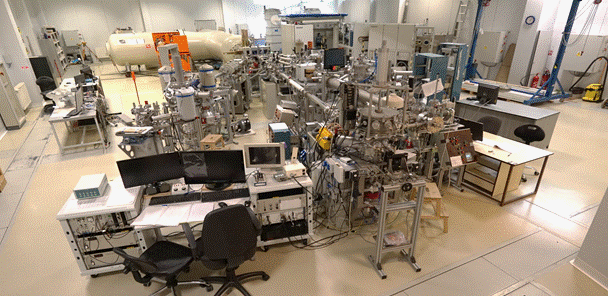
Figure 1. TANDETRON accelerator and beam lines at NPI. From left, general purpose IBM line with external beam stage, ion micro-beam line, high energy implantation line, TOF-ERDA and RBS channelling line.
The Tandetron accelerator can provide ion beams of almost all elements, with the exception of noble gases heavier than helium. Typical beam energies range from 400 keV up to several MeV for protons and helium ions, and from 10 to 30 MeV for heavier ions.
The ion beams are used for materials analysis, ion‑beam modification of materials, radiation hardness testing, dosimetry, and particle detector testing. These applications cover a broad spectrum of scientific and technological fields. Typical examples of experiments performed at the Tandetron accelerator and description of used IBA methods will be presented.
The research has been carried out at the CANAM (Centre of Accelerators and Nuclear Analytical Methods) infrastructure LM 2015056. The authors acknowledge the assistance provided by the Advanced Multiscale Materials for Key Enabling Technologies project, supported by the Ministry of Education, Youth, and Sports of the Czech Republic. Project No. CZ.02.01.01/00/22_008/0004558, Co-funded by the European Union.” – AMULET project.