Mg/Fe distribution in clinoferrosilite from 3D ED data
M. Klementová1, L. Palatinus1, R. Skála2
1FZU-Institute of Physics of the Czech Academy of Sciences, Na Slovance 2, 182 00 Prague, Czechia
2Institute of Geology of the Czech Academy of Sciences, Rozvojová 269, 165 00 Prague, Czechia
klemari@fzu.cz
Site occupancy in minerals is an important parameter in earth and planetary science, as it may reveal the geological history of the involved phases. In particular, the studies of intracrystalline exchange reflect temperatures and/or pressures of crystallization or system closure, or they may indicate cooling rates for a rock hosting a given mineral. Procedures have been developed and calibrated for common simple silicates like olivine, garnet or pyroxene mostly because they represent important rock-forming minerals. The thermodynamic basis of intracrystalline geothermometry in monoclinic pyroxenes (M2M1T2O6) is governed by the Fe²⁺–Mg exchange equilibrium between the two crystallographically distinct octahedral sites (M1 and M2) within the pyroxene structure.
We have studied clinoferrosilite from an inclusion in the Muong Nong-type tektite (indochinite) from Laos. The studied inclusion is round about 8 micrometers in diameter. It is mostly composed of sulfides – Ni-rich pentlandite and Fe-rich pyrrhotite. However, the most enigmatic phase is its magnesium rich rim formed by clinoferrosilite. Clinoferrosilite was studied by the 3D electron diffraction technique and the structure its structure was refined using the dynamical approach. The results were compared with the clinoferrosilite data available in the ICSD database.
Our data of Fe occupancy closely follow the trendlines (Figure 1), which means that the dynamical refinement of 3D ED data gives results comparable to the established techniques of X-ray diffraction and Mössbauer spectroscopy. And therefore, the method can be used for full geological interpretation and comparison with XRD data.
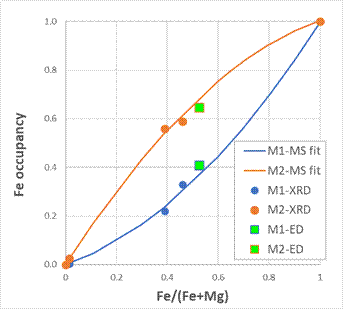
Figure 1. Fe occupancy in clinoferrosilite. Trendlines display fits based on the Mössbauer spectroscopy data from [Angel 1998].
1. R.J. Angel, C. McCammon, A.B. Woodland, Phys Chem Minerals 25, (1998), 249.
CzechNanoLab project LM2023051 funded by MEYS CR is gratefully acknowledged for the financial support of the measurements at LNSM Research Infrastructure.