Azimuthal integration of diffraction images: geometry, physical corrections, and NXazint format
Z. Matěj1, F. H. Gjørup1,2, M. Yazdi-Rizi1, P. Bell1, W. De Nolf3, M. R. V. Jørgensen1,2
1MAX IV Laboratory, Lund University, Lund, Sweden
2Department of Chemistry & iNANO, Aarhus University, Aarhus, Denmark
3ESRF – The European Synchrotron, Grenoble, France
zdenek.matej@maxiv.lu.se
Powder diffraction experiments at accelerator‑based light sources predominantly employ transmission geometries with flat (2D) area detectors positioned downstream of the sample. This configuration enables efficient recording of complete Debye–Scherrer rings, taking advantage of the high diffracted intensities at low and intermediate scattering angles. When combined with large, fast detectors, it supports high‑throughput as well as time‑resolved powder diffraction measurements.
The use of 2D detectors preserves the full azimuthal distribution of the diffracted intensity, providing access to information on preferred orientation, grain statistics, and other deviations from ideal powder averaging. For routine structural analysis, detector images are typically reduced by azimuthal integration (AZINT) to yield one‑dimensional diffraction profiles that follow the conventional powder diffraction formalism and serve as standard input for Rietveld refinement [1] and other quantitative methods. When deviations from ideal powder averaging are significant, azimuthally resolved integration or two‑dimensional intensity representations can be employed, retaining directional information that enables a more comprehensive characterization of texture and related effects.
Azimuthal integration can be performed using several established software packages, including fit2d [2], PyFAI [3], diffpy.srxplanar [4], Nika [5], and the AZINT module [6]. These software tools or processing pipelines typically provide a wide range of configuration options. Core corrections commonly include solid‑angle and polarization corrections, as well as intensity normalization. Additional, more specialized corrections may be applied when required, such as absorption or scattering effects arising from the sample, sample holder, or sample environment, as well as parallax corrections. More advanced functionality may include dedicated normalization and error‑propagation models, along with treatments accounting for correlations between neighbouring points in powder diffraction patterns [4]. Complementing AZINT software, a variety of mature programs are available for subsequent data analysis steps; a non‑exhaustive list of tools commonly used for Rietveld refinement includes GSAS‑II [7], TOPAS [8], Jana2020 [9], and MStruct [10].
Powder diffraction patterns and AZINT data have historically been stored in a wide range of predominantly text‑based formats. However, modern time‑resolved or spatially resolved experiments [11] at synchrotron light sources can practically produce hundreds of thousands to millions of diffraction patterns within minutes, making data handling and management increasingly challenging. To address this, most light sources worldwide have adopted the HDF5 data format as a versatile container for large volumes of hierarchically organized data and metadata. In addition, several diffraction instruments employ the NeXus [12] data standard built on top of HDF5, with the NXmx [13] application definition representing the current gold standard for macromolecular crystallography [14].
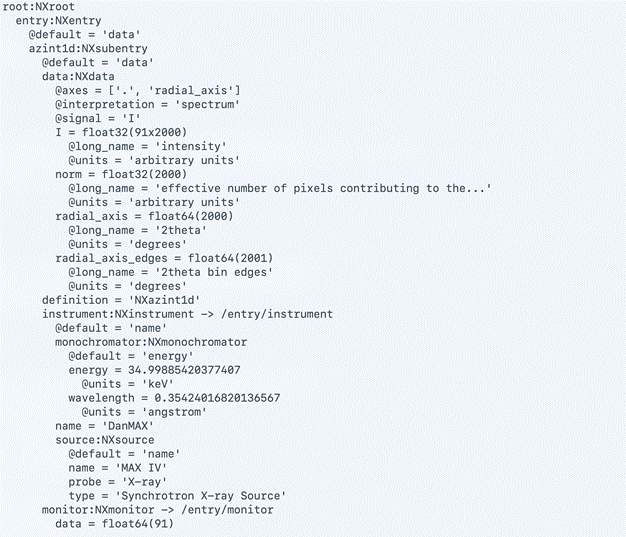
The first part of this contribution reviews the basic principles of azimuthal integration and the most commonly applied corrections used during data reduction. This discussion provides the foundation for the second part, which introduces the recently developed NXazint [15,16] format (Fig. 1). NXazint is designed to store 1D and 2D azimuthally integrated data together with essential metadata, enabling direct use in downstream analysis software. The format adheres to FAIR data principles, facilitates the handling of large datasets, and improves interoperability across beamlines and facilities. NXazint is already deployed at the MAX IV synchrotron, and broader adoption by other facilities and data analysis software is encouraged. The format is not intended to replace the pdCIF standard [17] but rather to serve as a complementary data container.
|
|
|
Figure 1. Screenshot of a fragment of the NXazint formatted file, illustrating how 1D and 2D azimuthally integrated data and associated metadata are structured within the NeXus. |
1. H. M. Rietveld, J. Appl. Cryst., 2, (1969), 65. doi:10.1107/S0021889869006558
2. A. P. Hammersley, S. O. Svensson, M. Hanfland, A. N. Fitch, D. Hausermann, High Press. Res., 14, (1996), 235. doi:10.1080/08957959608201408
3. J. Kieffer, J. P. Wright, Powder Diffraction, 28 s2, (2013), 339. doi:10.1017/S0885715613000924
4. X. Yang, P. Juhas, S. J. L. Billinge, J. Appl. Cryst., 47, (2014), 1273. doi:10.1107/S1600576714010516
5. J. Ilavsky, J. Appl. Cryst., 45, (2012), 324. doi:10.1107/S0021889812004037
6. azint: python module for Azimuthal Integration, https://maxiv-science.github.io/azint/, (April 29th, 2026).
7. B. H. Toby, R. B. Von Dreele, J. Appl. Cryst., 46, (2013), 544. doi:10.1107/S0021889813003531
8. A. A. Coelho, J. Appl. Cryst., 51, (2018), 210. doi:10.1107/S1600576718000183
9. V. Petříček, L. Palatinus, J. Plášil, M. Dušek, Z. für Kristall. - Cryst. Mat., 238, (2023), 271. doi:10.1515/zkri-2023-0005
10. Z. Matěj, A. Kadlecová, M. Janeček, L. Matějová, M. Dopita, R. Kužel, Powder Diffraction, 29 s2, (2014), 35. doi:10.1017/S0885715614000852
11. E. K. Christensen, T. Moriishi, T. Komori, Faraday Discussions, 261, (2025), 446. doi:10.1039/d5fd00009b
12. M. Konnecke, F. A. Akeroyd, H. J. Bernstein, A. S. Brewster, S. I. Campbell, B. Clausen, S. Cottrell, J. U. Hoffmann, P. R. Jemian, D. Mannicke, R. Osborn, P. F. Peterson, T. Richter, J. Suzuki, B. Watts, E. Wintersberger, J. Wuttke, J. Appl. Cryst., 48, (2015), 301. doi:10.1107/S1600576714027575
13. NXmx: functional application definition for macromolecular crystallography, https://manual.nexusformat.org/classes/applications/NXmx.html, (April 29th, 2026).
14. B. J. Bernstein, A. Förster, A. Bhowmick, A. S. Brewster, S. Brockhauser, L. Gelisio, D. R. Hall, F. Leonarski, V. Mariani, G. Santoni, C. Vonrhein, G. Winter, IUCr-J, 7, (2020). 784. doi:10.1107/S2052252520008672
15. NXazint1d: Application definition for data from two-dimensional area detectors that has been integrated azimuthally …, https://manual.nexusformat.org/classes/applications/NXazint1d.html, (April 29th, 2026).
16. R. V. Jørgensen, F. H. Gjørup, M. Yazdi‑Rizi, Z. Matej, W. De Nolf, P. Bell, J. Synchrotron Rad., 33, (2026), 896. doi:10.1107/S1600577526004224
17. POWDER CIF DICTIONARY, https://www.iucr.org/resources/cif/dictionaries/cif_pd, (April 29th, 2026).