Uniaxial-Strain Tuning of the Metal-Insulator Transition in k-(BEDT-TTF)2Cu[N(CN)2]Br
P. Doležal1,2, T. Pinter1, K. Boniecki1, A. Chen1, R. Saito3, A Kawamoto3, A. Pustogow1
1TU Wien, Institute of Solid State Physics, 1040, Vienna, Austria
2Charles University, Dep. of Condensed Matter Physics, 121 16, Prague, Czech Republic
3Hokkaido University, Dep. of Physics, Graduate School of Sci., 060-0810, Sapporo, Japan
petr.dolezal@matfyz.cuni.cz
The organic charge transfer salts are intensely studied compounds for their unique physical properties, in particular the single-band Mott metal-insulator transition and frustrated magnetism. This is the reason why these compounds serve as an experimental playground for the theoretical investigation of Hubbard model on the half-filled triangular lattice of quantum-spin-liquid candidates [1]. The layers of cations and anions with weak bonding create the quasi-2D character and enable large compressibility which allows modification of their physical properties in a large area in the phase diagram. It can be realized by application of hydrostatic or uniaxial pressure or by chemical substitution. While these mechanical properties are advantageous for tuning the physical properties, on the other side the performance of such experiments is very challenging because these compounds are also very brittle. Only very recently the in situ uniaxial-strain tuning of correlations and frustration strength within a single crystal became accessible [2].
Here we report the first controlled tuning of the Mott transition via uniaxial strain on free-standing organic single crystals in a piezoelectric strain cell. This versatile tool enables us to tune through the metal-insulator transition in a quasi-continuous fashion at cryogenic temperatures, as shown in Fig. 1. Due to negative chemical pressure upon substitution of 1H by 2D this compound exhibits Mott-insulating behaviour with an antiferromagnetic ground state at ambient pressure [3]. Here, we modified the strength of electronic correlations by uniaxial compression, yielding metallic and superconducting properties (Fig. 1a,b).
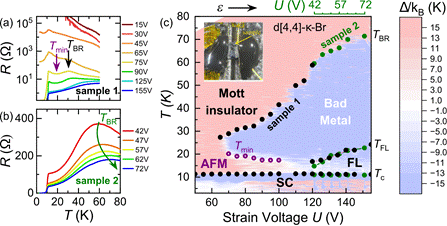
Figure 1. a), b) Electrical resistivity of d[4,4]-k-Br under uniaxial strain. c) The resulting phase diagram.