Polymorphism and cooperative phase transitions in C6-BTBT (x=4,6,8) molecular crystals
P. Brázda, K. Gurung. J Rohlíček
Institute of Physics of the Czech Academy of Sciences, Na Slovance 1999/2, 18200 Prague 8, Czechia
brazda@fzu.cz
Cooperative phase transitions are diffusionless and reversible phase transitions caused by a concerted displacement of molecules, atoms, and ions in crystals. They are generally associated with interesting macroscopic phenomena, such as the tuning of the mechanical properties of the materials undergoing the transition and shape-shifting effects, and they have been extensively studied in metals, inorganic alloys and ceramics [1]. Reports on cooperative polymorphic transitions of molecular crystals are still rare and the molecular mechanisms underlying these peculiar transformations are still largely unknown [1-3]. Understanding these processes can lead to an unprecedented control of molecular polymorphism that might be exploited in a wide range of fields, e.g., drugs development, high-energy materials, next-generation electronic and optoelectronic materials, or soft actuators.
One class of molecules potentially exhibiting cooperative phase transitions is BTBT with symmetrical long aliphatic hydrocarbon side chains (Figure 1).
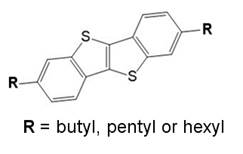
Figure 1 BTBT with butyl, pentyl and hexyl side chains.
So far, reported structures of these compounds at room or low temperatures showed nearly only so-called herringbone packing of the molecules, alternatively, p-stacking was also observed in a few cases (Figure 2). The known structures for each molecule were only up to two polymorphs and no transitions between herringbone and p-stacking was reported.
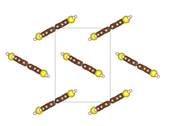
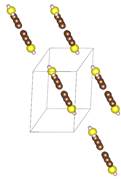
Figure 2 Example of herringbone (left) and p-stacking (right) packing of the aromatic cores of Cx-BTBT.
We prepared the starting materials both by crystallization from solvent and by sublimation, including direct sublimation on TEM grids. Further, we combined powder x-ray diffraction, which provided a quick identification of phase transition temperatures and 3D electron diffraction to solve crystal structures. Imaging in TEM was also used to study shape-shifting of the crystals during phase transitions.
Study of C4-BTBT revealed two new polymorphs apart from the known room temperature one crystallizing in P-1 space group (Figure 3) which adopts p-stacking packing. Transition to P21/a_HT polymorph occurs above 350K and the packing of this polymorph is herringbone. Cooling below 220K leads to transition to P21/a_LT polymorph, which has p-stacking packing of the cores. Substantial shape-shifting was observed for P21/a_LT to P-1_RT phase transition (Figure 4).
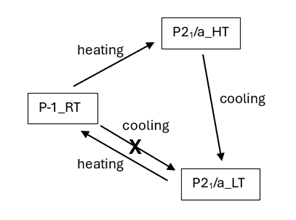
Figure 3 phase transitions of C4-BTBT.
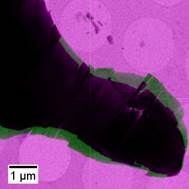
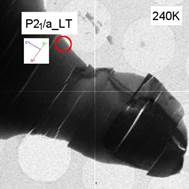
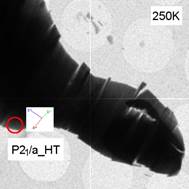
Figure 4 Transformation of C4-BTBT P21/a_LT to high temperature phase, presumably P-1_RT according to XRPD.
We identified five different polymorphs of C6-BTBT. Two room- and three low-temperature polymorphs. The room temperature polymorphs show both herringbone packing. They are polytypes, one with primitive unit cell and the other with I-centered cell. The nearly pure polymorph with centered cell was prepared only by sublimation on TEM grids. The crystals prepared by crystallization from solvent had primitive unit cell and often showed competition between these two polytypes resulting in specific diffuse scattering. Below 250K, the room temperature P21/a phase transforms to P-1_HT phase, which still adopts the herringbone packing. Cooling below 230K leads to transition to C2/c structure with p-stacking packing and further cooling below 90K leads to transition to P-1_LT with a different p-stacking packing (Figure 5). Figure 6 shows significant shape-shifting in transition from C2/c to P21/a.
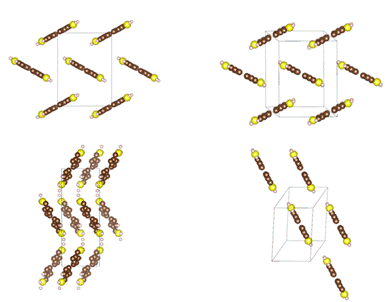
Figure 5 Left to right, top to bottom structures of C6-BTBT (only aromatic cores shown) P21/a (herringbone), P-1_HT (herringbone), C2/c (p-stacking) and P-1_LT (p-stacking).
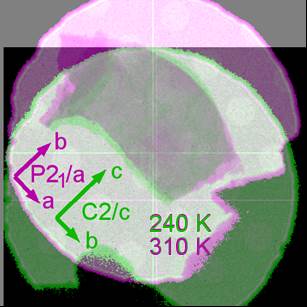
Figure 6 C6-BTBT transition from C2/c to P21/a.
C8-BTBT showed four different polymorphs. One room-temperature and three low-temperature. The room-temperature one is analogous to C6-BTBT structure. Also the phases at the lowest temperature are analogous (P-1_LT). The difference occurs upon transition to room-temperature P21/a, where C8-BTBT material transforms via a transition phase stable only in a narrow (about 20K) temperature range, which is incommensurately modulated. The modulation is very strong and affect mainly the distance between the p-stacked aromatic cores. The last observed phase was affected by a very strong disorder, so its structure could not be solved. The structure is very probably similar to C6-BTBT C2/c, but the layer stacking is virtually random and oscillates between primitive and C-centered polytypes. A situation similar to room-temperature polytypes of C6-BTBT.
1. S.K. Park, Y. Diao Martensitic transition in molecular crystals for dynamic functional materials Chem. Soc. Rev. 2020, 49, 8287-8314.
2. A.J. Zaczek, L. Catalano, P. Naumov, T.M. Korter Mapping the polymorphic transformation gateway vibration in crystalline 1,2,4,5-tetrabromobenzene Chem. Sci. 2019, 10, 1332-1341.
3. M. Asher et al. Mechanistic View on the Order–Disorder Phase Transition in Amphidynamic Crystals J. Phys. Chem. Lett. 2023, 14, 6, 1570-1577.
The cooperative phase transition research was supported by the Czech Science Foundation, grant number 24-12403S.