HOST–GUEST INTERACTIONS IN MIL-140C: COMPUTATIONAL AND EXPERIMENTAL STUDY WITH FOCUS ON PARACETAMOL ENCAPSULATION
Javier García1, Miroslav Pospíšil1, Jan Demel2, Matouš Kloda2,
1Charles University, Ke Karlovu 3,12116 Prague 2
2 Institute of Inorganic Chemistry, CAS, Husinec-Řež č. p. 1001
jorgejgarciaj@outlook.com
Metal–organic frameworks (MOFs) of the MIL‑140 series (A, B, C, D) combine high structure stability with one‑dimensional channels with a diameter of ~10 Å, making them very attractive for drug delivery. In this work we present a combined computational and experimental study on paracetamol encapsulation in MIL‑140C. Computational pre-screening of nine common drugs was built in Materials Studio (Forcite module, Universal force field (UFF), rigid framework). Paracetamol was ranked as the most affine guest, exhibiting the lowest total potential energy (–223.26 kcal/mol) for two molecules per cell, (Tab. 1). A testing of concentration series for paracetamol (2–8 molecules per cell), (Tab. 2), predicted an optimal loading of four molecules, (Fig.1), which reached the total minimum potential energy (–237.70 kcal/mol) and showed favourable head‑to‑tail hydrogen bonding with the framework.
Based on these calculation predictions, MIL‑140C was synthesised and the best crystalline sample was selected for adsorption tests with paracetamol and different solvents. Simulated powder X‑ray diffraction (PXRD) patterns of the loaded MOF (four paracetamol per cell) show subtle peak shifts and intensity variations compared to the empty framework (Fig. 2), (experimental data pending) consistent with pore occupation. Experimental BET measurements of the paracetamol‑loaded sample gave a reduction of surface area (Tab. 3). This decrease, together with the absence of crystalline paracetamol peaks in experimental PXRD (data pending), strongly suggests encapsulation of paracetamol molecules rather than mere surface adsorption.
We explicitly discuss the limitations of our simulations (rigid framework, (UFF), no solvent, idealised crystalline structure) and argue that while computational screening is valuable for ranking affinities, quantitative predictions require more advanced methods. Our integrated approach demonstrates that MIL‑140C is a viable platform for paracetamol delivery. Four‑molecules of paracetamol were the most efficient loading. These calculation models can serve as the first step of prediction of host-guest interaction of various drugs, which will be subsequently tested in in-vitro studies.
Table 1. Energy comparison of nine pairs of guest molecules tested on MIL-140C
Guest Molecule |
Total potential energy [kcal/mol] |
Paracetamol |
-223.26 |
Ibuprofen |
-3.30 |
Atenolol |
16.04 |
Bisphenol A |
17.19 |
Diclofenac |
21.04 |
Carbomazepine |
56.61 |
3-Hydroxycarbamazepine |
61.10 |
Caffeine anhydrous |
92.34 |
Sulfamethoxasol |
219.15 |
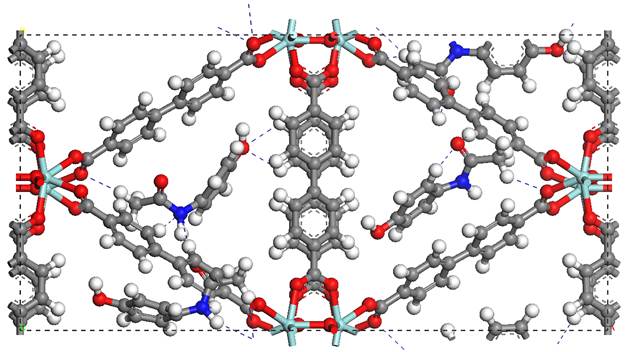
Figure 1. Most stable position of four molecules of paracetamol per unit cell of MIL‑140C, after quench dynamics (Forcite, UFF). The blue scattered lines represent hydrogen bonds
Table 2. Energy comparison of different amounts of paracetamol
# of Paracetamol |
Total binding energy [kcal/mol] |
Binding energy per paracetamol [kcal/mol] |
2 |
-90.76 |
-45.38 |
3 |
-115.26 |
-38.42 |
4 |
-237.70 |
-59.43 |
5 |
-45.17 |
-9.03 |
6 |
-41.36 |
-6.90 |
7 |
-40.71 |
-5.81 |
8 |
-2.41 |
-0.30 |
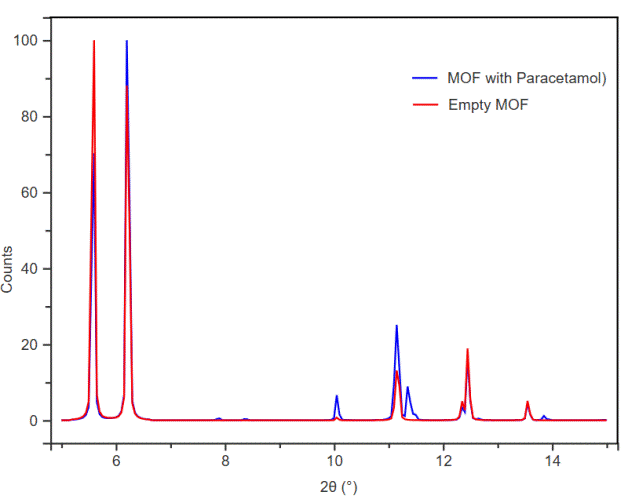
Figure 2. Comparison of simulated Powder X-Rays diffraction of the empty MOF(RED), MOF filled with 4 paracetamols(BLUE).
Table 3. Experimental BET surface areas (N₂ adsorption, 77 K) of MIL‑140C with different solvents
Sample |
Solvent |
BET [m2 /g] |
Change vs. pure MOF |
MIL-140C (pure) |
---- |
862.8 |
---- |
MIL-140C + paracetamol |
2-Propanol |
774.4 |
–10.2 % |
MIL-140C + paracetamol |
Tetrahydrofuran |
789.7 |
–8.5 % |
MIL-140C + paracetamol |
Ethyl acetate |
762.8 |
–11.6 % |
MIL-140C + paracetamol |
Chloroform |
74.8 |
–91.3 % |