Challenges in crystallization of protein-DNA complexes
A. Maďarová1,2, J. Škerlová1, I. Sieglová1, M. Fábry1, P. Řezáčová1
1Institute of Organic Chemistry and Biochemistry, Czech Academy of Sciences, Prague, Czech Republic
2Department of Cell Biology, Faculty of Science, Charles University, Prague, Czech Republic
anna.madarova@uochb.cas.cz
The SarA (=Staphylococcal accessory regulator) family is a group of eleven bacterial transcriptional regulators which control the expression of various virulence factors, regulate biofilm formation and mediate stress responses [1]. Due to their central role in the regulation of virulence as well as their unique species-specificity, SarA family proteins represent particularly attractive targets for the development of a completely novel generation of antibiotics [2]. Although many SarA family proteins are well annotated in terms of their regulon and the apo-form structure, their molecular mechanism of DNA recognition remains unknown. To date, no 3D protein-DNA structure of any of the SarA family members is available. This poses a significant knowledge gap as without a solved protein-DNA structure, we cannot fully comprehend how these proteins precisely regulate transcription and how they recognize their cognate operators nor identify residues that could be targeted for the most efficient disruption of their DNA binding ability.
We have therefore set out to fill this gap by crystallizing the SarA and SarR proteins in complex with DNA duplexes derived from their native operators. We successfully purified and characterized various protein constructs, tested their ability to bind the designed DNA duplexes and employed various crystallization techniques and conditions. Despite having obtained a myriad of crystals of different morphology with various DNA constructs and performing extensive crystallization optimization, the crystals did not diffract. To investigate this phenomenon further, we carried out negative stain TEM of our protein-DNA crystals (Figure 1), which revealed lattice disorder within the crystals [3]. This technique helped us guide further optimization, select different protein constructs and get protein-DNA crystals that diffracted to roughly 9 Å. Currently, we are intensively working on further optimization of these crystals.
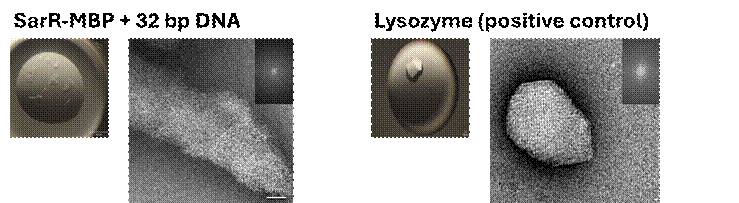
Figure 1. Negative stain of fragmented crystals.
1. Cheung, A. L., Koomey, J. M., Butler, C. A., Projan, S. J., & Fischetti, V. A. (1992). Regulation of exoprotein expression in Staphylococcus aureus by a locus (sar) distinct from agr. Proceedings of the National Academy of Sciences, 89(14), 6462–6466. doi:10.1073/pnas.89.14.6462
2. Balamurugan, P., Praveen Krishna, V., Bharath, D., Lavanya, R., Vairaprakash, P., & Adline Princy, S. (2017). Staphylococcus aureus Quorum Regulator SarA Targeted Compound, 2-[(Methylamino)methyl]phenol Inhibits Biofilm and Down-Regulates Virulence Genes. Frontiers in Microbiology, 8. doi: 10.3389/fmicb.2017.01290
3. Weiss, S., Vergara, S., Lin, G., Calero, G. (2021) Detection of Microcrystals for CryoEM. Methods Mol Biol., 2215:299-307. doi: 10.1007/978-1-0716-0966-8_14
This project is supported by the Project OP JAC CZ.02.01.01/00/22_008/0004575 RNA for therapy, co-funded by the European Union.