Bentonite Research for Czech Deep Geological Repository of
Nuclear Waste: What Does XRD Tell Us?
F. Laufek1, M. Koubová1, J. Svoboda2, M. Kučerová2, R. Vašíček2, M. Sczerba3
1Czech Geological Survey, Geologická 6, 152 00 Praha 5, Czech Republic
2Czech Technical University, Faculty of Civil Engineering, Prague, Czech Republic
3Institute of Geological Sciences, Polish Academy of Sciences, Senacka 1, 31-002 Krakow, Poland
frantisek.laufek@geology.cz
Bentonite is an absorbing swelling clay material consisting mainly of minerals from a smectite group. Smectites are expandable aluminium phyllosilicate minerals, with very small crystallites and large surface area. This property makes them excellent adsorbent. Therefore, bentonites are considered to be the most suitable materials for the multibarrier system of a deep geological repository (DGR) of high-level radioactive waste. Most concepts of DGR consider temperatures up to 100 °C. An increase in temperature could led to cost savings due to increasing disposal capacity. The relevant mineralogical research on bentonite material at 200°C has been performed to clarify to mineralogical and geochemical changes that occur during heating. Pelletized bentonite extracted from Černý vrch deposit (BCV) and processed at Keramost Ltd. Obrnice Plant (Most, Czech Republic) was used as a tested material. The BCV material represents Czech Mg-Ca bentonite and consists of mainly of montmorillonite, minority of kaolinite, quartz, illite, Mg-calcite, goethite and traces of other carbonates including siderite and ankerite.
The conducted research consists of two parts. The first part investigates the effect of long-term thermal loading up to 200 °C on the properties of the bentonite barrier within a mock-up in-situ experiment conducted in the Josef Underground Research Laboratory (Figure 1), Smilovice-Chotilsko, ČR. The results provide insight into the changes occurring in the bentonite as a function of the distance from the heater and contribute to the assessment of the stability of Ca–Mg type bentonite under elevated temperature conditions in the initial period of the lifetime of the DGR. The second part presents a complementary laboratory programme and summarizes the results of the study of BCV bentonite subjected to thermal loading at 200 °C under dry conditions. These laboratory experiments simulate a worst-case thermal scenario (200 °C), associated with intensive drying of the bentonite in the vicinity of the disposal canister shortly after its emplacement in a deep geological repository for high-level radioactive waste.
Powder X-ray diffraction was applied for monitoring the mineralogical composition of studied bentonite. XRD was also used in determination of the layer charge of smectite. Permanent layer charge is an important intrinsic property of smectites which stems in general from cation substitutions in the octahedral and/or tetrahedral sheet or from vacancies in the octahedral sheet. The procedure involving Cu-triethylenetetramine complex (Cu-Trien) exchange followed by ethylene glycol (EG) solvation, registered via XRD was used primarily for distinguishing the layer charge. The laboratory experiments confirmed a decrease in cation exchange capacity and a reduction in the average layer charge of smectite as a result of Mg²⁺ fixation [2]. Subsequent rehydration tests demonstrated only partial reversibility of these changes. Mineralogical and geochemical analyses of samples collected during the dismantling of the experiment demonstrated that the thermal impact on the bentonite is spatially limited to a narrow zone in the immediate vicinity of the heater.
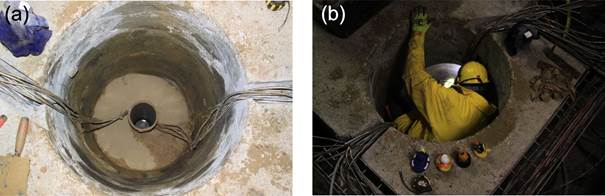
Figure 1 (a) Bentonite barrier within a mock-up in-situ experiment conducted in the Josef Underground Research Laboratory during dismantling of the experiment. The heating housing tube is visible in the centre. (b) Sampling of bentonite samples for mineralogical analysis with the dismantling procedure.