Role of X-ray Diffraction in Investigating Structural Properties of Functional Materials
C. Martinez-Tomas1, O. Klymov1,2, S. Agouram1, D. Kurbatov3, A. Opanasyuk3, and V. Muñoz-Sanjosé2
1University of Valencia, Dr.
Moliner 50, 46100 Burjassot, Spain
2FZU-Institute of
Physics of the Czech Academy of Sciences, Na Slovance 2, 18200 Praha 8, Czechia
3 Sumy State University, Kharkivska St. 116, 40007 Sumy, Ukraine
klymov@fzu.cz
X-ray diffraction (XRD) is one of the most effective and accessible methods for studying the structure of functional semiconductor materials, especially when defects and internal distortions play an important role. Its capabilities were illustrated for Zn1-xMnxTe thin films with 5 pct. Mn content, where the addition of alloying element introduces structural disorder. High-resolution XRD data were analyzed using a modified Williamson–Hall (W–H) approach, which makes it possible to distinguish between the effects of crystallite size and lattice strain while also considering directional (anisotropic) broadening caused by defects. The results show that peak broadening is mainly governed by strain (microstrain ~10-3), while the crystallite size remains relatively large (>100 nm). The analysis also reveals dislocation densities on the order of ~1014–1015 m-2, increasing with Mn content, indicating a higher level of structural defects. The films exhibit a preferred (111) orientation, and pole figures confirms partial strain relaxation and slight crystal misorientation (tilt of a few tenths of a degree). When combined with complementary techniques such as SEM and HRTEM, XRD method enables a more complete and consistent understanding of structural properties across different length scales. This makes it a key tool for understanding how material structure influences the performance of functional thin films in applications such as optoelectronics and spintronics.
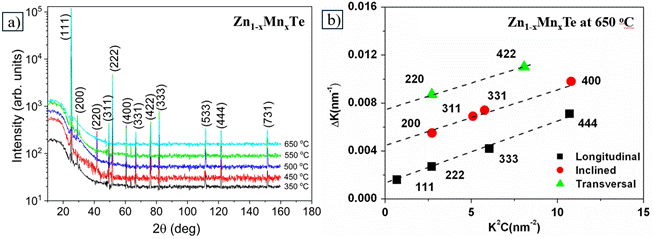
Figure 1. (a) X-ray Diffraction patterns of Zn1-xMnxTe films with a nominal Mn content of 5%, deposited on glass substrates by close-space vacuum sublimation (CSVS) at different substrate temperatures; (b) modified Williamson–Hall plot of the Zn1-xMnxTe film grown at 650 °C.
The work has been supported by the Spanish Generalitat Valenciana (Projects Nos. ISIC/2012/008 and PrometeoII/ 2015-004) and Spanish MINECO (Project No. TEC2014-53727-C2-1-R). Authors acknowledge the SCSIE (University of Valencia) for providing access to advanced characterization facilities.
1. Martinez-Tomas, C., Klymov, O., Agouram, S. et al., “Substructural Properties and Anisotropic Peak Broadening in Zn1-xMnxTe Films Determined by a Combined Methodology Based on SEM, HRTEM, XRD, and HRXRD”, Metall Mater Trans A 47, 6645–6654 (2016).
2. T Ungár, "Microstructural parameters from X-ray diffraction peak broadening", Scripta Materialia, 51 (8), pp. 777-781 (2004)
3. Fewster, P. F., X-ray Scattering from Semiconductors, London, U.K.: Imperial College Press, (2003)