XRDlicious: Recent developments in an interactive platform for powder XRD and structural analysis
Miroslav Lebeda1, 2, 3, Jan Drahokoupil1, 3, Petr Veřtát1, Petr Vlčák3
1FZU – Institute of Physics of the Czech Academy of Sciences
2Faculty of Nuclear Sciences and Physical Engineering, Czech Technical University in Prague
3Faculty of Mechanical Engineering, Czech Technical University in Prague
lebedmi2@cvut.cz
Over the past year, we have developed XRDlicious, an interactive application primarily intended for rapid calculation and comparison of theoretical powder X-ray diffraction (XRD) patterns and partial radial distribution functions (see Fig. 1 for an illustration of the interface). We now report on its development, recent improvements, and usage metrics. Among the main additional functionalities are: (1) an integrated search of the MP, MC3D, and COD databases via their public APIs, allowing users to easily retrieve and work with crystal structures directly within the interface; (2) structure visualization and modifications (e.g., atomic species, occupancies, or lattice parameters) to explore their influence on the resulting diffractograms; and (3) convenient conversion between common file types (.xrdml, .ras, and .xy), improving compatibility across various data formats. Developed using Streamlit, the application is also available online (https://xrdlicious.com) and is designed with an emphasis on accessibility and ease of use.
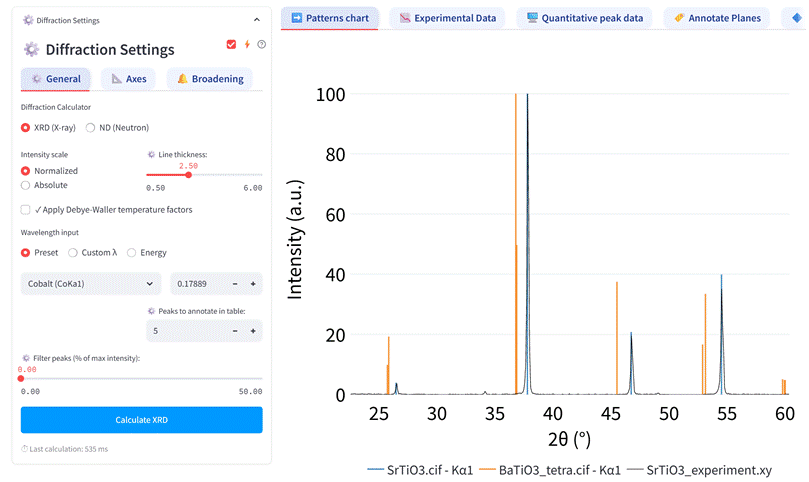
Fig. 1: XRDlicious interface for calculation and comparison of powder XRD patterns.