The Effect of Thermal Annealing on the Structure of Organic Semiconductor Thin Films and Powders
J. Čekal, A.F.B. Melécot, D. Varshney and J. Novák
Department of Condensed Matter Physics, Faculty of Science, Masaryk University
Kotlářská 267/2, 611 37 Brno
547890@mail.muni.cz
Organic semiconductors are a relatively new type of material used in applications such as organic solar cells, organic field-effect transistors, and OLED displays. Understanding their thin-film behaviour at elevated temperatures is crucial for the designing of these devices. In this work, we focus on the behaviour of thin films and powders of 2,3,6,7,10,11-Hexamethoxytriphenylene (HMTP) and 1,4,5,8,9,11-Hexaazatriphenylenehexacarbonitrile (HATCN) molecules during thermal annealing. The main goal of this work was to study phase transitions and the temperature dependence of lattice parameters, focusing on anisotropic behaviour and a potential difference between thin film and powder material. We used in-situ X-ray diffraction (XRD) during annealing to address the material properties. Additionally, we compare reliability and efficiency of three data-fitting methods for the determination of the lattice parameters.
HMTP and HATCN are organic semiconductors with a hexagonal crystal structure. In the HMTP crystal, molecules form a brickwork arrangement. The methoxy groups of one molecule fit into the empty space between the aromatic nuclei of the molecules lying in the planes above and below. This minimises steric hindrance and repulsion between aromatic rings. The lattice parameters of HMTP crystals are reported as 13.1240(13) Å and 6.8481(7) Å in the a and c directions, respectively [1]. In contrast, the arrangement of HATCN molecules in the crystal is more complicated. The molecules form ladder-like chains. The overall crystal arrangement is governed by perpendicular π interactions between the electrons of the heterocycle and the cyano group of the neighbouring molecule. This results in a 3D hexagonal arrangement in the crystal. The reported lattice parameters are 23.537(3) Å and 14.834(3) Å in the a and c directions, respectively [2].
The HMTP film was prepared using molecular beam epitaxy on a graphene substrate coated on 4H-SiC. The HATCN film was prepared by the drop-coating method from an acetone solution.
Due to the different crystal preferential orientations of the samples, various XRD techniques were used. For powder diffraction measurements (PXRD), we used a symmetric scan employing beam collimated by pinholes and a 2D detector. It was sufficient to use the symmetric out-of-plane scan to probe strong HMTP 0002 reflection for the HMTP film. On the other hand, for the HATCN film, the signal was weak in the out-of-plane direction film. Therefore, we used an in-plane scan in the grazing incidence X-ray diffraction (GIXRD) geometry in this case. All measurements were performed using a Rigaku SmartLab 3 diffractometer equipped with a 9 kW Cu rotation anode. The in-situ annealing experiments in the temperature range 30 °C to 140 °C were performed in nitrogen protection atmosphere using a DHS 1100 annealing chamber by Anton Paar GmbH. HMTP and HATCN powders were enclosed in Kapton capsules to avoid material displacement during air suction and nitrogen flushing in the annealing chamber.
As for data processing, we compare reliability and efficiency of the Rietveld, Le Bail, and Cohen methods [3] to obtain lattice parameters temperature dependency out of collected XRD data. For the Rietveld method, which requires a correct structure model, we assumed fixed internal structure of the unit cell as obtained from a Crystallographic Information File. For the Le Bail method, which only requires the space group and initial lattice parameters as an input, peak intensities are treated as free parameters. We used implementation of the Rietveld and Le Bail methods in the FullProf programs package [4]. The Cohen method, which depends on a correct peak indexation only but requires absence of overlapping peaks, was used to verify the results of the other two methods. The anisotropic coefficients of linear thermal expansion (CLTE) α (1) were calculated from the lattice parameters temperature dependences.
|
|
(1) |

Where  is lattice parameter and
 is temperature. The dependences of lattice coefficient
c for powders of HMTP and HATCN are shown in Fig. 1 and Fig. 2, respectively.
is temperature. The dependences of lattice coefficient
c for powders of HMTP and HATCN are shown in Fig. 1 and Fig. 2, respectively.
The CLTE values obtained from lattice parameters calculated by the different methods are relatively close with overlapping confidence intervals (Tab. 1). The Cohen method showed lower accuracy for our data, which is noticeable in Fig. 2. Although modeling of the crystal preferential orientation was applied in the Rietveld method , the Le Bail whole-pattern decomposition proved to be the most robust and precise method for our specific goal of extracting lattice parameters, yielding the lowest uncertainties and ignoring complex intensity variations [3].
|
|
|
Figure 1. Values of c lattice parametres for HMTP powder. |
Figure 2. Values of c lattice parametres for HATCN powder. |
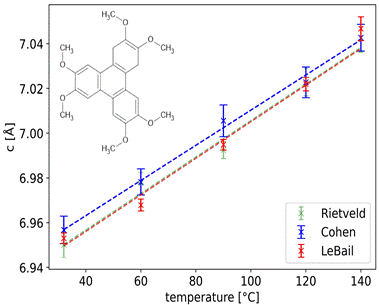
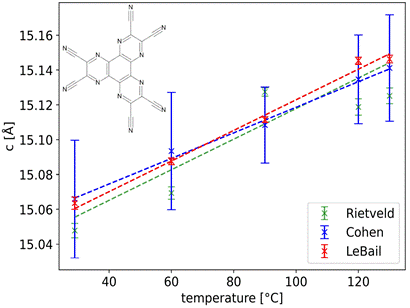
Table 1. Table of calculated CLTE in a and c crystal directions for HMTP and HATCN films and powders obtained by different fit methods.
|
Sample |
Fitting method |
αa [10-5 K-1] |
αc [10-5 K-1] |
Mean χ2 |
|
HMTP- film |
- |
- |
12.68 ± 0.16 |
- |
|
HMTP-powder |
Cohen |
-0.5 ± 0.9 |
11.3 ± 1.0 |
- |
|
|
Rietvield |
0.3 ± 9.2 |
11.8 ± 1.0 |
23.82 |
|
|
Le Bail |
0.3 ± 0.5 |
11.8 ± 0.5 |
10.73 |
|
HATCN- powder |
Cohen |
3.8 ± 2.4 |
4.9 ± 2.5 |
- |
|
|
Rietvield |
3.7 ± 0.4 |
5.8 ± 0.3 |
4.74 |
|
|
Le Bail |
4.0 ± 0.2 |
5.9 ± 0.2 |
2.04 |
|
HATCN- film |
Rietvield |
5.5 ± 1.9 |
5.7 ± 1.7 |
2.49 |
|
|
Le Bail |
6.1 ± 0.7 |
6.9 ± 0.9 |
1.51 |
We found that neither the structural model nor the usage of the specific space group provided a good fit for the HMTP powder data which is indicated by indicated by the high mean χ2 values in Tab. 1. Additionally, we observed a large thermal expansion anisotropy in the CLTE for the HMTP powder, along with an indication of negative thermal expansion (NTE). According to recent research, the phenomenon of NTE in organic crystals is not as rare as previously assumed [5]. This behaviour in HMTP crystals likely originates from strong intermolecular hydrogen bonds parallel to the crystallographic a-axis, contrasted by much weaker interactions along the c-axis, perpendicular to the molecular plane. The CLTE of the HMTP film is slightly higher than that of the powder, likely due to interactions with the substrate. For HATCN, the CLTE along the c-direction is nearly identical for both the powder and the film; however, along the a-direction, the film exhibits a value approximately 50% higher than the powder.
1. T. L. Andresen, F. C. Krebs, N. Thorup, K. Bechgaard, Chem. Mater., 12, (2000), 2428.
2. P. S. Szalay, J. R. Galán-Mascarós, R. Clérac, K. R. Dunbar, Synth. Met., 122, (2001), 535.
3. V. K. Pecharsky, P. Y. Zavalij, Fundamentals of Powder Diffraction and Structural Characterization of Materials, Second Edition. New York: Springer. 2009.
4. J. Rodríguez-Carvajal, FullProf Suite Manual, Version 8.20. Grenoble: Institut Laue-Langevin. 2025
5. A. van der Lee, D. G. Dumitrescu, Chem. Sci., 12, (2021), 8537.
CzechNanoLab Research Infrastructure (ID 90251), funded by MEYS CR, is gratefully acknowledged for the financial support of the measurements/sample fabrication.