Rh-Mn-Sb Heusler compounds in thin films
Esther de Prado1, Artem Shamardin1, Stanislav Cichoň1, Jan Duchoň1, Michal Rameš1, Ladislav Fekete1, Jaromír Kopeček1, Šimon Šťastný2, Aleš Melzer2, Michal Hubert2, Martin Veis2, Ján Lančok1, Oleg Heczko1
1FZU-Institute of Physics of the Czech Academy of Sciences, Na Slovance 1999/2, Prague 18000, Czech Republic
2Institute of Physics of Charles University, Ke Karlovu 2026/5, Prague 12116, Czech Republic
Heusler compounds constitute a broad family of intermetallic materials, with more than 1500 possible compositions reported to date. Among them, the Rh–Mn–Sb system has attracted scientific interest for nearly half a century1. However, although bulk Rh–Mn–Sb alloys were studied several decades ago, experimental work on this system has since remained very limited, and thin films have not been explored. In this context, Rh₂MnSb full-Heusler thin films were epitaxially grown for the first time on MgO(001) substrates by DC magnetron sputtering at deposition temperatures of 600, 700, and 800 °C2. Films with a nominal thickness of 200 nm were systematically characterized in terms of their structural, morphological, optical, magneto-optical, and magnetic properties. The sample deposited at 600 °C was close to stoichiometric and exhibited an almost perfectly ordered L2₁ structure. All films exhibited a tetragonal structure and a regular twinned microstructure, in which most twin domains were oriented with the c-axis perpendicular to the film surface, presumably as a result of the constraint imposed by the substrate. Magnetic measurements for the film grown at 600 °C yielded a Curie temperature of about 220–275 K and a saturation magnetization of approximately 55 emu/g at 10 K, both close to bulk values, while magneto-optical Kerr measurements indicated paramagnetic behavior at room temperature. These results demonstrate the potential of Rh₂MnSb thin films and motivate further work aimed at improving compositional precision and structural control.
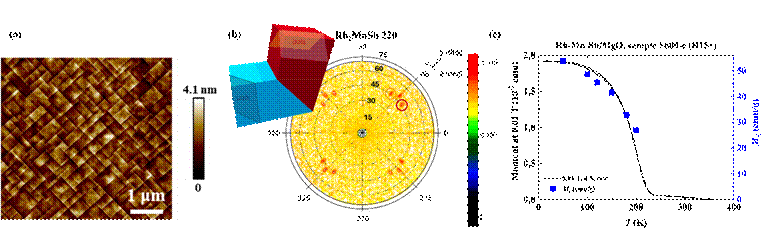
Figure 1: (a) AFM topography image of a Rh₂MnSb film deposited at 600 °C; (b) structural model of twin-related tetragonal Rh₂MnSb variants and corresponding {220} pole figure; and (c) thermomagnetic curves measured at 0.01 T.
1. F.A. Hames, J. Crangle, “Ferromagnetism in Heusler-Type Alloys Based on Platinum-Group or Palladium-Group Metals,” Journal of Applied Physics 42 (1971) 1336–1338.
2. Shamardin, A.; Cichoň, S.; de Prado, E.; Duchoň, J.; Rameš, M.; Fekete, L.; Kopeček, J.; Šťastný, Š.; Melzer, A.; Hubert, M.; Veis, M.; Lančok, J.; Heczko, O. Twinning in ferromagnetic Heusler Rh₂MnSb epitaxial thin films. Journal of Alloys and Compounds 1042 (2025) 184143