In Situ Synchrotron X-ray Diffraction Study of the Evolution of ω Particles and the β-ω Transition Region During Heating
J. Šmilauerová, J. Kozlík, J. Dittrich, V. Holý
Faculty of Mathematics and Physics, Charles University, Ke Karlovu 5, 121 16, Prague, Czech Republic
jana.smilauerova@matfyz.cuni.cz
The β→ω transformation in metastable β‑Ti alloys plays a central role in controlling mechanical properties and lattice instabilities. Nanoscale ω particles form by a shuffle mechanism that can be formally described as a collapse of two neighbouring (111)β planes of the body-centred cubic β matrix toward their intermediate position, while the next (111)β plane remains unchanged. Repeating this shuffle pattern gives rise to the hexagonal structure of the ω phase particles [1]. At elevated temperatures, the ω phase evolves further via a diffusion-assisted, displacement-controlled process in which alloying elements are rejected from the ω particles into the surrounding β matrix, while the collapse of the (111)β planes proceeds simultaneously [2]. An important aspect of the β→ω transformation is that the interface between the two phases is not sharp; instead, the degree of (111)β plane collapse progresses gradually in the transition region between ω and β. Earlier work has shown that specific reflections are systematically absent in both β and ideal ω lattices but are allowed in regions of incomplete collapse, providing diffraction signatures of the β-ω transition region [3].
Using in situ high‑energy synchrotron X‑ray diffraction, we track the evolution of ω and transitional‑phase peaks during controlled heating of a single‑crystalline β‑Ti sample (Ti‑15 wt.% Mo). By analysing integrated intensities and peak shapes in selected regions of reciprocal space (see Figure 1), we determine temperature‑dependent ω particle sizes and quantify the relative thickness of the transition region using a model based on ellipsoidal ω particles with a diffuse interface, in which the degree of collapse changes smoothly from ideal ω to ideal β structure.
The thermal evolution of the ω phase proceeds in several distinct stages. Between room temperature and approximately 250 °C, the ω phase partially dissolves, as indicated by a simultaneous decrease in both the number and size of ω particles. In the temperature range from about 250 °C to 420 °C, the remaining ω particles undergo pronounced growth while their total number continues to decrease, resulting in a sharp increase in the integrated ω intensity. Between 420 °C and 530 °C, the particle sizes remain approximately constant, but the ongoing reduction in particle number leads to a gradual decrease in the integrated intensity. Above roughly 530 °C, as the ω phase approaches its solvus temperature, a rapid reduction in particle size signals the final dissolution of ω.
The evolution of the β–ω transition region is more difficult to quantify due to the intrinsically weak intensity of the corresponding diffraction peaks. Nevertheless, the integrated intensity of the transition‑region peaks remains approximately constant over most of the temperature range, with a modest increase accompanying the rapid growth of ω particles and a pronounced decrease coinciding with their dissolution above 530 °C. Analysis of the transition‑region width relative to the ω‑particle size reveals an initial broadening during the low‑temperature dissolution stage, followed by a narrowing that coincides with the temperature interval of rapid ω‑particle growth.
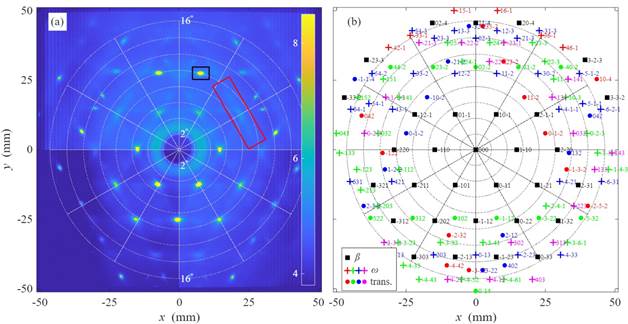
Figure 1. An example of the reciprocal-space maps analysed in this study. (a) Detector image recorded at room temperature; black and red rectangles indicate the regions of interest around ω and transition-region peaks, respectively. (b) Calculated positions of β, ω and transition-region peaks. The four colours of the ω and transition maxima correspond to four crystallographically equivalent ω families.
1. D. De Fontaine, Acta Metallurgica, 18, (1970), 275.
2. T. W. Duerig, G. T. Terlinde, J. C. Williams, The ω-phase reaction in titanium alloys in Titanium ‘80 Science & Technology ‐ Proceedings of the 4th Int’l Conference on Titanium, (1980), 1299.
3. J. Šmilauerová, P. Harcuba, D. Kriegner, V. Holý, Journal of Applied Crystallography, 50, (2017), 283.
This work was supported by a project of the Czech Science Foundation (GACR) project no. 23-09637L. Single crystal growth was performed in MGML (http://mgml.eu/), which is supported by the Czech Research Infrastructures program (project No. LM LM2023065). The authors would like to acknowledge ESRF for providing beamtime through the experiment MA6531 (https://doi.org/10.15151/ESRF-ES-2243238109) and beamline staff at ID11 beamline for assistance during the experiment.