Crystal structure study of the semiconducting system Ag-In-VI (VI = S, Se, Te) by X-ray powder diffraction
Gerzon E. Delgado1, Asiloé J. Mora1, Tibaire
Tinoco2, Carlos Pineda2
1Laboratorio de Cristalografía, Departamento
de Química, Facultad de Ciencias,
2Centro de Estudios Avanzados en Óptica, Departamento de Física, Facultad de Ciencias,
Universidad de Los Andes, Mérida 5101, Venezuela.
Introduction
The ternary silver chalcogenides of the type Ag-In-VI (VI = S, Se, Te) form very stable stoichiometric compounds with potential application in non-linear optics and solar cells [1,2], due to its electro-physical properties independent of impurities [2]. Stoichiometric compounds with three compositions can be found: AgInVI2, AgIn3VI5 and AgIn5VI8. These materials belong to the normal structure compounds (I III VI2) and the defect structure compounds (I III3VI5, I III52VI8), respectively [3]. Compositions of the type AgIn3VI5 has not been reported in the literature. In this work, we present the structural characterization of some members of the system Ag-In-VI, using X-ray powder diffraction.
Experimental
The samples were synthesized by the melt and annealing technique. Stoichiometric quantities of Ag, In and X (S, Se, Te) were evacuated in sealed quartz ampoules and deposited into an one zone furnace, and then submitted to direct fusion. Chemical analysis of the resultant ingots were carried out with a Hitachi S-2500 SEM equipped with a Kevex EDX accessory. Small quantities of each the samples were ground mechanically in an agate mortar and pestle. The resulting fine powders were mounted on a flat zero-background holder. The X-ray powder diffraction data were collected at room temperature, in q/q reflection mode using a Siemens D5005 diffractometer (Bragg-Brentano) equipped with an X-ray tube (CuKα radiation; 40kV, 30mA) and a diffracted beam graphite monochromator. All the Rietveld refinements were carried out using the Fullprof program [4] available in the software package WinPlotr [5].
Results and discussion
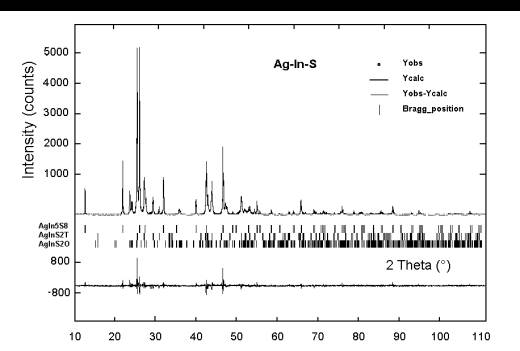
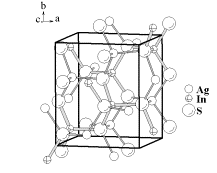
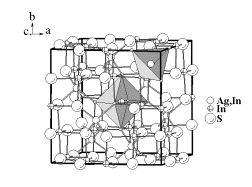
In the Ag-In-S system, three phases were simultaneously characterized from a single X-ray powder diffraction pattern using the Rietveld method [6]. The X-ray powder pattern was composed of AgIn5S8 (42.7%), AgInS2 tetragonal phase (32.7%) and AgInS2 orthorhombic phase (24.6%) [7]. The AgIn5S8 crystallizes in the cubic space group Fd-3m, Z = 8, with a = 10.8265(2) Å, in a spinel-type structure. The description of the structure of AgIn5S8 in this space group implies a random distribution of the Ag and In atoms among the tetrahedral sites. The AgInS2 ternary compound crystallizes in two polymorphs: a tetragonal chalcopyrite-type phase (I-42d), Z = 4, with unit cell parameters a = 5.8760(2) Å, c = 11.2007(7) Å, and an orthorhombic wurtzite-like phase (Pna21), Z =4, with a = 6.9972(6) Å, b = 8.2733(6) Å, c = 6.6939(6) Å. These structures can be described as a derivative of the sphalerite structure and the wurtzite structure, respectively. Ag-S and In-S average distances in both structures are 2.58(5) Å and 2.44(5) Å, respectively.
|
|
AgInS2
(orthorhombic, Pna21)
AgIn5S8
(cubic, Fd-3m) |
|
a) |
b) |
|
Figure 1. (a) Final Rietveld refinement
plot for the three phases of the Ag-In-S system. (b) Unit cell diagram of AgInS2
(orthorhombic) and AgIn5S8 (cubic) phases. |
|
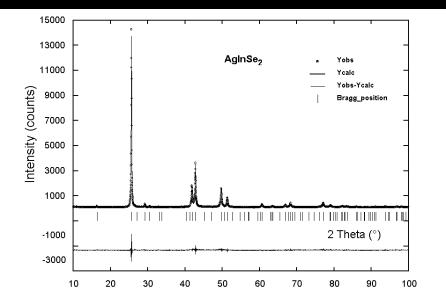
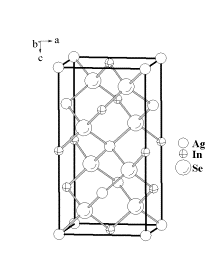
For the Ag-In-Se system, a chalcopyrite-type structure was found with composition AgInSe2. This compound crystallizes with tetragonal symmetry (I-42d) and unit cell parameters: a = 6.1010(8) Å, c = 11.708(2) Å. The Ag-Se bond distance is 2.621(2) Å and In-Se 2.593(2) Å.
|
|
AgInSe2
(tetragonal, I-42d) |
|
Figure 2. Final Rietveld refinement
plot for AgInSe2 and unit cell diagram. |
|
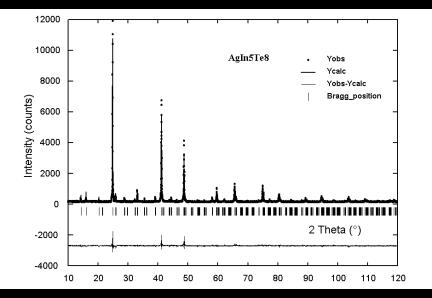
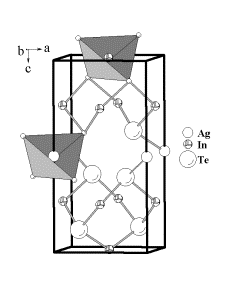
For the Ag-In-Te system, AgIn5Te8 is isostructural with the AgIn5Se8 compound [8]. Crystallize in the tetragonal space group P-42m with a = 6.1952(2) Å, c = 12.419(4) Å, and consists of a three-dimensional arrangement of distorted AgTe4 and InTe4 tetrahedra connected by common faces [9]. The Ag-Te [2.890(6) Å] and In-Te [2.764(7) Å] bond distances agree well with those observed in other adamantane structures such as AgGaTe2, LiInTe2, CuInTe2, MnIn2Te4 and CdIn2Te4.
|
|
AgIn5Te8
(tetragonal, P-42m) |
|
Figure 3. Final Rietveld refinement plot for AgIn5Te8
and unit cell diagram showing the tetrahedral coordination around the
cations. |
|
Acknowledgement
This study was supported by the CDCHT-ULA and FONACIT (Lab-97000821).
1. A. El-Korashya, M. A. Abdel-Rahima, and H. El-Zahed, Thin Solid Films, 338 (1999) 207-212.
2. N. S. Orlova, I. V. Bodnar, and E. A. Kudritskaya, Inst. Phys. Conf. Series, 152 (1998) 147-150.
3. J. M. Delgado, Inst. Phys. Conf. Series, 152 (1998) 45-50.
4. J.
Rodriguez-Carvajal, Fullprof, version 2.55, LLB, CEA-CNRS, France (2004).
5. T Roisnel and J. Rodríguez-Carvajal, Mater. Sci. Forum, 378-381 (2002)118-123.
6. H.M. Rietveld, J. Appl. Cryst., 2 (1969) 65-71.
7. G.E. Delgado, A.J. Mora, C. Pineda, T. Tinoco, Mater. Res. Bull., 36 (2001) 2507-2517.
8. P. Benoit, P, Charpin and C. Djega-Mariadassou, Mater. Res. Bull., 18 (1983) 1047-1057.
9. A.J. Mora, G.E. Delgado, T. Tinoco, C. Pineda, Accepted in phys. stat. sol. (a).