Phase
equilibria, crystal and magnetic structure of solid solutions LaFe1-xCoxO3-d (0£x£1)
N.V.
Proskurnina, V.I. Voronin
Institute of Metal Physics, Ural Division of Russian Academy
of Sciences, S. Kovalevskoi
Str.18, Ekaterinburg GSP-170, Russia
Perovskite-type
oxides La1-xAxMeO3 (A=Ba, Sr, Ca; Me-
transition metal) have been extensively studied for over four decades due to
their catalytic activities, unique magnetic, electrical and transport
properties [1, 2] making these materials promising for different applications.
In these compounds the rare earth element plays an important role to stabilize
the structure, and the electronic ground state of 3d-transition metal (TM) ‘B’
is responsible for the magnetic and transport properties. The similarity of the
structure to high-TC superconductors and recent observation of giant
magneto-resistance in hole doped LaMnO3 have attracted a great
interest in these compounds [3–5]. Therefore, manganites have been intensively
investigated in recent years. At the same time Sr-, Ca- and Ba-doped cobaltites
and ferrites can be used as gas-dense oxygen permeable ceramic membranes for
gas conversation [6-8]. The possibility of creation of such devices is being
studied nowadays. A number of
scientific papers give much information about the phase equilibria and physical
properties of solid solutions LnFe1-xCoxO3, as
a rule, when Ln = (La0.3Sr0.3) the structure is
stabilized by Sr and therefore this solution exists in a continuous range of
concentration [9]. However, no detailed structural LaFe1-xCoxO3-d studies have been carried out.
The samples of
the general composition LaFe1-xCoxO3-d (0£x£1) with a step of 0.05 were prepared
using different routes. First route was a traditional ceramic technique of
three-stage firing in air in the temperature range of 850-1100°C for 100-300 hours with intermediate
regrinding in ethanol. Another routes were preparation through amorphous
precursors using nitric or citric acid as solvent. The final thermal treatment
involved heating in air at 1100°C for about 150 hours. In order to
identify phase composition all samples were examined by X-ray diffraction using
a DRON-3 diffractometer with Cu-Ka radiation (10°£2q£75°). It is known that determination of
the oxygen location in solid oxides by means of X-ray diffraction analysis lead
to relatively large uncertainties. Therefore, neutron diffraction was used
additionally for the crystal and magnetic structure determination. The powder
neutron diffraction profiles were measured using neutron diffractometer D7a
(wavelength of 1.5152 Е) at room temperature at the research reactor
IVV-2, located near Yekaterinburg, Russia. For all single phase samples unit
cells parameters and magnetic structure were calculated and refined by Rietveld
analysis. Structural analysis was carried out by simultaneous refinement of
neutron and X-ray powder diffraction data.
According to
the X-ray analysis initial LaCoO3-d has a cubic perovskite structure
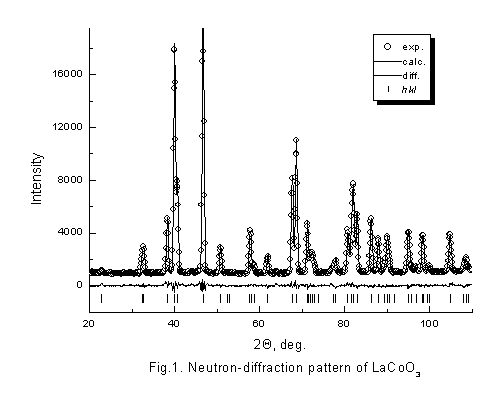
with rhombohedral distortions (space group R-3c). Rietveld neutron
powder diffraction profile of this sample at room temperature is shown in
figure 1. Single phase of the solid solution of following composition LaFe1-xCoxO3-d was obtained in a range of concentrations 0£x£0.25. It is shown that the volume
and unite cell parameters are continuously increase as the iron content
increases. It caused by the ionic size difference: an ionic radius of Fe3+
is larger than ionic radius of Co3+.
Lanthanum
ferrite LaFeO3 was described in Pbnm space group with
orthorhombic distortions [10]. All single phase samples LaCo1‑yFeyO3-d exist within the composition range
0.775£y£1.0. In the samples in intermediate
region both orthorhombic and rhombohedral boundary phases were simultaneously
identified as LaCo0.75Fe0.25O3 и LaCo0.225Fe0.775O3.
It should be noted that single phase regions of LaCo1‑yFeyO3-d are narrower than the regions of Sr-stabilized solutions La0.7Sr0.3Co1‑yFeyO3-d [9].
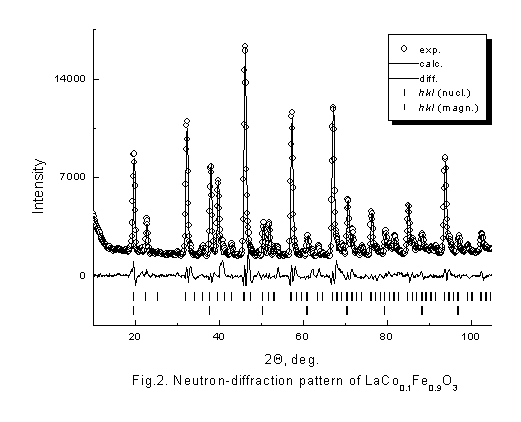
In several reflexes
some additional intensity of LaCo0.1Fe0.9O3
was determined. It is known that the
pure lanthanum ferrite is an antiferromagnetic (G-type) with QN= 750K [11-12]. Analysis of magnetic reflexes
of experimental neutron diffraction profile of composition LaCo1‑yFeyO3-d shows that antiferromagnetic G-type structure
realize in this compound at room temperature (Fig.2). The magnitude of magnetic
moment is 3.55(5) mB on “average” iron atom in a unite cell.
All
rhombohedral phases LaCo1‑yFeyO3-d don’t have a magnetic moment at room
temperature what is in a good agreement with data obtained for the LaCoO3-d in [13-14].
Work supported by State Scientific Research Program “Topical
Problems in Physics of Condensed Matter”, direction “Neutron Investigations of
Condensed Matter” (State control No. 40.012.1.1.11.50), the basic research
program of the Department of Physical Sciences of the Russian Academy of
Sciences "Neutron studies of the substance structure and fundamental
properties of matter" and Program for Support to Leading Scientific
Schools of Russia (Project No. NS-639.2003.2).
1. Jonker
G.H. and Van Santen J.H., Physica 16
(1950) 337.
2. Reccah
P.M. and Goodenough J.B. Phys. Rev. 155 (1967) 932.
3. Jin S.,
Tiefel T.H., McCormack M., Fastnacht R.A., Ramesh R. and Chen L.H., Science 264
(1994) 413.
4. McCormack
M., Jin S., Tiefel T.H., Fleming R.M., Phillips J.M. and Ramesh R. J. Appl.
Phys. Lett. 64 (1994) 3045.
5. Von
Helmholt R., Wecker J., Holzapfel B., Schultz L. and Samwer K. Phys. Rev. Lett.
71 (1993) 2331.
6. Dong
Hoon Lee, Hong Seok Kim, Jeong Yong Lee et.al. Solid State Comm. 96
(1995) 445.
7. Wold
A., Croft W. J. Phys. Chem. 63 (1959) 447.
8. Nitadori
T. and Misono M. J. of Catalysis 93 (1984) 459.
9. Sathey
V.G., Paranjpez S.K., Sirugurix V. and Pimpaley A.V. J. Phys.: Condens. Matter 10
(1998) 4045–4055.
10. Geller
S., Wood E.A. Acta Cryst., 9 (1956) 563.
11. Koehler
W.C., Wollan E.O. J. Phys. Chem. Solids 2 (1957) 100.
12. Koehler
W.C., Wollan E.O., Wilkinson M.K. Phys. Rev. 118 (1960) 58.
13. Goodenough
J.B., Wold A. et al. Phys. Rev. 124 (1961) 373.
14. Voronin
V.I., Karkin A.E., Petrov A.N. et al. Physica B 234-236 (1997) 710.