CRYOGENIC TEMPERING FOR IMPROVEMENT OF X-RAY CRYSTAL DIFFRACTION
Svetlana Antonyuk1, Alexander Popov2, Vladimir Barynin3 & Victor Lamzin2
1 The Institute of
Crystallography, Russian Academy of Sciences, Leninsky pr.59,
Moscow 117333, Russia;
2 EMBL Hamburg Outstation, c/o DESY,
Notkestrasse 85, 22603, Germany;
3 The Krebs Institute of
Biomolecular Research, Department of Molecular Biology and
Biotechnology, The University of Sheffield, Sheffield S10 2TN,
UK.
Detailed understanding of various living processes can be gained from structural studies of biological macromolecules. The most powerful method for that is single crystal X-ray diffraction. X-ray crystal data collection is nowadays technically easy due to phenomenal advances in the use of synchrotron radiation, area detectors and cryogenic freezing. The most important achievement of cryogenic freezing is a great reduction of radiation damage and thus increased crystal life time. However cryogenic freezing typically increases mosaicity of the crystal and sometimes adversely affects crystal diffraction. We describe the cryogenic tempering of the crystals of di-Mn catalase, which in our hands has essentially eliminated the mosaicity increase and, in addition, greatly enhanced the quality of the X-ray diffraction.
Di-Mn catalase from Thermus thermophilus is an ultra thermostable enzyme. It utilises an unusual di-Mn active site, which can acquire four different redox states. X-ray crystal structure of the reduced catalase has been determined to 1.6 A resolution. Higher resolution data are needed for elucidation of charge at the catalytic Mn ions and detailed structural interpretation of the active site architecture.
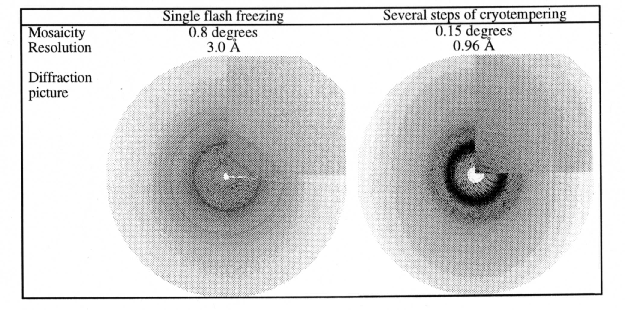
Crystals of di-Mn catalase were grown from 1.35 M ammonium sulphate, 0.1 M Mes buffer, pH 5.5. The crystals are vulnerable to radiation damage and thus cryogenic freezing is vital. Freezing of the catalase crystals was not straightforward. The only suitable ones were glycerol and PEG400. However addition of glycerol has increased the crystal mosaicity from 0.07 (room temperature) to about 0.7 while use of PEG has reduced the diffraction limit to 3 A. The cryogenic tempering, a process resembling a technique commonly used in material sciences, was applied. While the crystal was frozen in the cryostream, it was then transformed back to the PEG400 cryogenic solution. After the crystal had warmed up, it was flash frozen again. This procedure was repeated several times for the catalase crystals of different size and in all cases resulted in an outstanding improvement of both crystal mosaicity and resolution.