P4W20O68: Successive phase transitions toward charge density wave states
E. Duverger-Nédellec, K. Kolincio, A. Pautrat, O. Pérez,
CRISMAT ENSICAEN/ CNRS, 6 Boulevard du Maréchal Juin -
F-14050 CAEN cedex 4 FRANCE
olivier.perez@ensicaen.fr
Monophosphate tungsten bronzes (MPTBp) of general formula (PO2)4(WO3)2m (with 4 ≤ m ≤ 14) can be described as the regular stacking of WO3 slabs of ReO3–type structure and slices PO4 of groups [1]. MPTBp are low dimensionality oxides exhibiting successive transitions toward charge density (CDW) and/or spin density wave (SDW) states. These transitions lead to structural distortions associated to the appearance of satellite reflections. This family is relevant to analyse CDW and SDW states and their competition since by changing the m value the electronic anisotropy and the density of carriers can be tuned. An investigation of the phase transitions versus temperature as well as the structure determination of the different states has to be done for several members. The relationship between physical and structural properties could be then performed.
We decided to focus our attention on the MPTBp m=10: P4W20O68. This member is exhibiting a CDW state at room temperature (RT) and the solution of the modulated structure associated to the CDW state proposed by Roussel et al [2] is providing us a cornerstone for our study. Owing to the technical limits of the “old-fashion diffractometer” used by these authors, a few number of satellite reflections was collected and consequently only the atomic displacements of the tungsten species was modelled; an improvement of the description could be expected with a modern diffractometer (Apex2 CCD detector and high brilliance micro focus X-ray source).
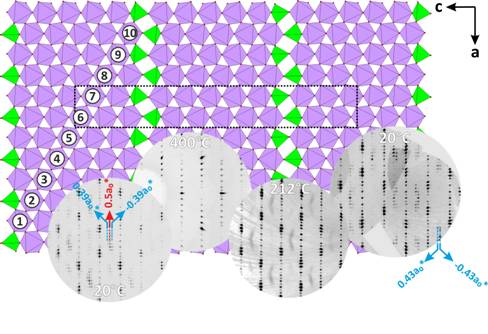
Figure 1: Ground state structure of P4W20O68 (green and violet colours are used for PO4 and WO6) and (h0l)* diffraction planes measured during the thermal cycle 20°C ð 400°C ð 20°C
The diffraction patterns observed by Roussel et al [2] were fully indexed using the following cell parameters a=5.30Å b=6.55Å c=35.82Å α=β=90°, γ=90.6° q=0.43a* and the superspace group P1121(σ100)0. Surprisingly, our measurements at RT are revealing a different pattern: the basic cell is also monoclinic but with b as unique axis and two wave vectors q1=0.5a* and q2=0.39a* are observed. The experiments performed versus temperature evidenced the ground state structure above 400°C with no more evidence of satellite reflections. Cooling the crystal up to RT different features can be observed (see fig-1): for T close to 210°C diffuse scattering with V shape is observed, reflections condense within the diffuse scattering around 200°C then the diffuse phenomenon fully disappears and at RT we are back to the CDW state with satellite reflections. However this CDW state is now the one observed by Roussel et al [2]. The present work is then evidencing the possibility to stabilize two different CDW states at RT for the m=10 MPTBp. The temperatures of the different transitions are accurately determined by monitoring the intensity of the satellite compared to the main reflections. Then a full data collection was performed for both states with a high resolution strategy (sample-detector distance larger than 10cm and fine slicing scanning mode) to limit the reflections overlapping and a structure solution is proposed. Finally the modifications of the WO6 environments are analysed via bond valence calculations to evidence electronic ordering within the WO3 slabs for the different states and these results are discussed in regards to electronic transport measurements.
1. Phosphate tungsten bronze series: crystallographic and structural properties of low-dimensional conductors; P.Roussel, O.Pérez and Ph.Labbé; Acta Cryst. B57, pp. 603-632 (2001)
2. P4W20O68: A complex charge-density-wave modulated structure with an antiferroelectric-like lattice distortion; P.Roussel, Ph.Labbé, H.Leligny, D.Groult, P.Foury-Leylekian, J.P.Pouget, Physical Review B 62, pp. 176-188 (2000)